


Philippines Import Data 2025–26: Top Products, Trade Partners & Market Insights
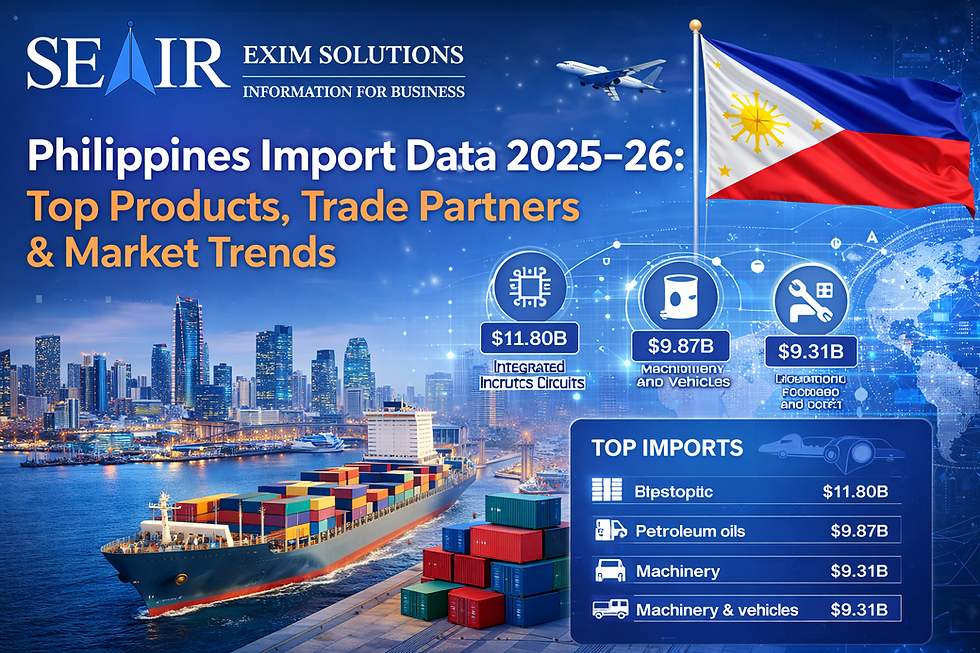
The Philippines, a fast-growing Southeast Asian economy, continues to strengthen its position in global trade. As a newly industrialized country in the Asia-Pacific region, it has demonstrated consistent economic expansion, supported by strong domestic demand and international trade activities.
In recent years, the country has emerged as a significant importer, ranking among the top global markets for essential commodities and industrial goods. Its import structure reflects a growing economy that relies on technology, energy resources, and consumer products to sustain development.
Philippines Imports Insights: Latest Trends
Recent trends indicate that imports are stabilizing after earlier fluctuations. Strong demand for industrial raw materials, fuel, and food products continues to drive growth.
By early 2026, the total Philippines import data is estimated to reach approximately $134.88 billion, maintaining steady momentum from late 2025. This growth highlights the country’s reliance on global supply chains and its expanding industrial base.
Key Import Highlights
Top Product Category (HS 27): Mineral fuels & oils
Top Technology Imports (HS 85): Electrical machinery
Fastest Growth Segment: Integrated circuits
Emerging Demand: Precious metals
Top Trade Partner: China
Philippines Import Data 2025 Overview
In 2025, the Philippines witnessed a recovery in trade, with a 9.2% increase in total trade volume during the first half of the year. Imports from January to October 2025 reached around $111.75 billion, reflecting a 4.3% year-on-year growth.
Major Import Categories (2025)
Electronic Products – 22.20%
Mineral Fuels & Lubricants – 13.00%
Transport Equipment – 9.90%
Industrial Machinery – 8.30%
Raw Materials – 36.20%
Consumer Goods – 20.80%
These Philippines major import List figures highlight the country’s strong dependence on electronics, fuel, and industrial inputs.
Philippines Import Performance 2023–2022 Comparison
The Philippines experienced a temporary decline in imports during 2023. Between January and October 2023, imports dropped by 9.57%, from $116.08 billion in 2022 to $104.97 billion in 2023.
This decline reflects global economic challenges but also indicates market correction after high import volumes in previous years.
Top Import Partners of the Philippines
The country maintains strong trade relationships, particularly within Asia. Its import network is highly diversified but dominated by regional economies.
Leading Trade Partners
China
Indonesia
Japan
South Korea
United States
Singapore
Thailand
Malaysia
Vietnam
China remains the largest supplier, followed by key Asian economies that provide essential resources, machinery, and technology.
Philippines’ Top Import Products
The Philippines top imports products a wide range of goods to support its industries and consumer demand. Below are the major imported products:
Electronic integrated circuits
Petroleum oils
Coal and solid fuels
Motor vehicles
Optical and medical equipment
Pharmaceutical products
Wheat and food grains
Electrical machinery
Vehicle parts and accessories
Iron and steel products
Detailed Insights
Electronic Integrated Circuits: Critical for electronics manufacturing and digital infrastructure.
Petroleum Oils: Essential for transportation and power generation.
Coal & Fuels: Support energy production across industries.
Motor Vehicles: Reflect growing demand for personal and commercial transportation.
Pharmaceutical Products: Ensure healthcare availability for the population.
How to Access Philippines Import Data
To understand the Philippines market, businesses need access to accurate and updated trade intelligence. Reliable data helps identify:
Top import products
Buyer and supplier networks
Market demand trends
Trade regulations and classifications
Using platforms like Seair Exim Solutions enables businesses to access verified shipment-level insights and make informed trade decisions.
Conclusion
The Philippines continues to grow as a major import-driven economy, with increasing demand for energy, electronics, and industrial goods. Its strong trade partnerships and diversified import structure make it a key player in the global market.
Understanding import trends, key products, and partner countries can help businesses identify new opportunities and expand their global presence effectively.
Comments